The reason imported CRO playbooks underperform in Thailand is that they assume a western conversion path: discovery on Google, research on the brand site, decision based on on-site content, checkout via card. That model exists in Thailand for some segments (corporate B2B, some expat-targeted services, premium consumer brands with established trust) but it is not the dominant path for most Thai-market commerce. The dominant path involves LINE as a research and comparison surface, PromptPay as the default payment method, and mobile-first interactions throughout. Sites that ship the western pattern miss conversion they would otherwise capture.
The five-stage Thai conversion journey
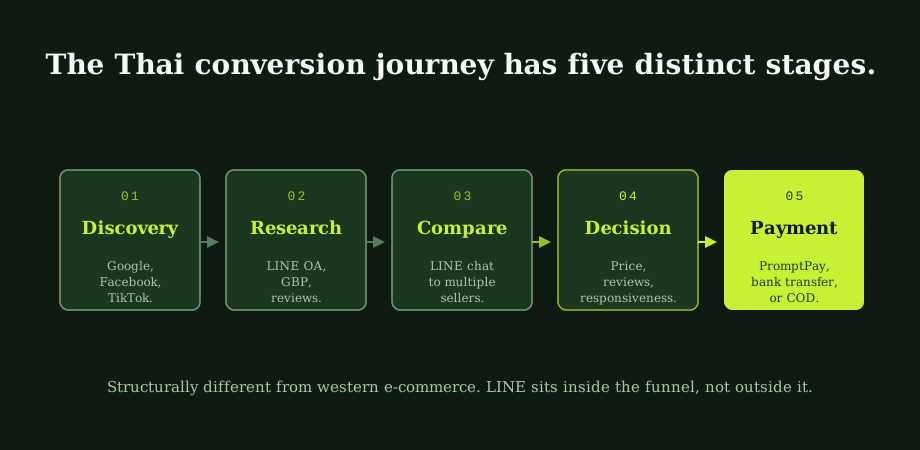
The structure of Thai customer behaviour is more usefully understood as a five-stage journey than as a traditional funnel.
Stage one: Discovery. The customer becomes aware of a need or product. The discovery channels for Thai consumers vary by demographic but typically include Google search (99.56 percent of search traffic in Thailand, per Google's market share in Thailand), Facebook (very high penetration), TikTok (rising fast for younger demographics), and word of mouth via messenger apps. At this stage the customer is exposed to the brand for the first time.
Stage two: Research. The customer investigates the brand. The research surfaces for Thai consumers are website visits (verifying the brand is real), Google Business Profile reviews (the trust check), LINE Official Account browsing (checking responsiveness and previous customer questions), and Facebook page activity (recent posts as a sign the business is active). A brand with thin presence on any of these surfaces loses trust at this stage.
Stage three: Comparison. The customer compares the brand to alternatives, often by chatting with multiple sellers in parallel via LINE. This is the stage that western CRO frameworks completely miss: the comparison is happening in chat windows, not on comparison-style web pages. Sellers compete on response time, quality of answers, language match (Thai with Thai customers, English with expats), and the human warmth of the interaction. The website's role in this stage is largely to legitimise the LINE conversation that follows.
Stage four: Decision. The customer decides which seller to buy from. The decision is driven by perceived value (price plus quality plus trust), reviews (specifically Thai-language reviews from named Thai customers), responsiveness during the comparison stage (slow LINE response loses sales), and incidental factors like LINE sticker friendliness or perceived professionalism of the LINE Official Account branding.
Stage five: Payment. The customer pays. PromptPay (the Thai QR-code instant transfer system) dominates lower-value transactions. Bank transfers handle larger purchases. Credit cards are a minority option for most Thai consumers and a meaningful option for some segments. Cash-on-delivery still matters for parts of the e-commerce market. Card-only checkout designed for western markets loses a measurable share of the Thai consumer base at this final stage.
Optimising any single stage in isolation produces less impact than optimising the journey across stages.
Lever one: LINE Official Account integration
LINE is to Thai e-commerce what Instagram DMs are to western fashion brands, except much more so. The chat-to-buy behaviour is the default expectation for many product categories. Sites that treat LINE as an afterthought (a small icon in the footer) systematically underperform sites that treat LINE as a primary conversion path.
The implementation that works in practice. Add a prominent LINE Official Account button (the green LINE branding is well-known and trusted) on the header of every page, the product or service pages, the contact section, and any page where a decision happens. Make the LINE button click-to-chat where possible, so customers can begin the conversation without re-typing. Set up the LINE Official Account itself with automated welcome messages, FAQ flows, and clear human handoff so that LINE response times stay short. The mechanics of how Thai businesses actually use LINE Official Account specifically are in LINE Official Account for Thai business.
The conversion lift from properly integrated LINE is rarely subtle. For Thai consumer businesses adding LINE buttons to previously LINE-light sites, conversion rate improvements of twenty to fifty percent are not unusual.
Lever two: Thai-language trust signals
Thai customers identify translated reviews quickly and discount them heavily. The phrasing, the names, the specific details that real Thai customers include all read differently from auto-translated content. A site with twenty thoughtful Thai-language reviews from named Thai customers builds more trust than a site with a hundred translated reviews from English-speaking customers.
The trust-signal stack that works for Thai audiences includes named Thai customer reviews with specific details (product or service used, the situation that drove the purchase, the outcome), Thai customer photos where the business model supports it (restaurants, services, products consumed visibly), Thai-language case studies for B2B businesses, and Thai-language testimonials from credible Thai sources. The wider trust-signal framework for YMYL content is in what is E-E-A-T and how does it affect rankings.
For bilingual sites serving both Thai and expat audiences, the trust signals should be language-matched: the Thai version shows Thai reviewers, the English version shows English reviewers. Mixing the two on the same page version reads as inauthentic to both audiences. The bilingual SEO framing is in Thai and English SEO: should you target both languages.
Lever three: Payment methods that Thai customers expect
PromptPay is the dominant payment method for most Thai consumer transactions. The QR-code instant-transfer system has near-universal Thai bank account penetration and effectively zero transaction friction. Cards are familiar but less preferred for many transaction sizes. Bank transfers (direct to account via online banking) are the default for higher-value purchases.
The conversion implications. Card-only checkouts lose the segment of Thai consumers who do not use credit cards or prefer not to use them for specific transactions. PromptPay-only fails for some B2B audiences who pay via corporate cards. The right answer for most consumer businesses is to offer PromptPay, bank transfer, and credit card options with PromptPay typically displayed first or most prominently. For lower-value e-commerce, cash-on-delivery still matters for some demographics and adding it can capture an additional five to fifteen percent of conversions depending on the product.
Beyond the payment methods themselves, the checkout-page design matters. Long forms with many required fields cause drop-off everywhere but particularly in the Thai market where mobile typing on smaller screens compounds the friction. Minimal required fields, with optional fields clearly marked as such, and integrated PromptPay QR display rather than off-site redirects produce noticeably better conversion than typical western-style checkouts.
Lever four: Mobile-first design
Mobile traffic dominates Thai e-commerce to a degree that western markets do not approach. Most Thai consumer sites see seventy to eighty-five percent of traffic from mobile devices; some categories sit above ninety percent. Desktop-first designs that work fine in Europe or the US look broken on Thai mobile devices, and the conversion penalty is severe.
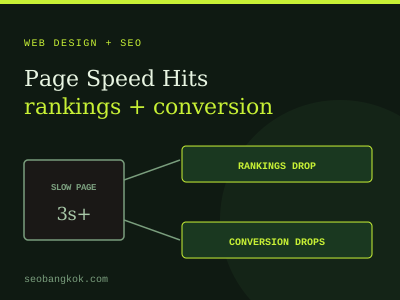
The mobile-first patterns that matter most for Thai conversion. Tap targets sized for thumbs (forty-four pixels minimum). LINE buttons prominently visible without scrolling. Phone numbers click-to-call. Address links click-to-open in Google Maps. Forms with mobile-friendly input types (number pads for phone numbers, calendar pickers for dates). Page-load speeds optimised for Thai mobile networks where 4G is the dominant connection. The page-speed-versus-conversion relationship specifically is in how page speed affects both your SEO rankings and your conversion rate.
The wider technical foundation that mobile-first design rests on is in Core Web Vitals explained; the local Thai context for mobile-dominant behaviour is in local SEO for Thailand businesses.
How CRO interacts with SEO and PPC
CRO is the multiplier on traffic that SEO and PPC bring. The interaction is straightforward: SEO and PPC deliver visitors, CRO determines what share of those visitors become customers. The two work together and improving either one in isolation produces less return than improving both.
The common mistake is investing in acquisition (SEO and PPC budgets going up) while leaving the conversion path unchanged. Doubling traffic at a 1.5 percent conversion rate produces fewer sales than holding traffic constant at 3 percent conversion rate. For most Thai businesses with established traffic but mediocre conversion, the highest-return investment is fixing the conversion path before increasing acquisition spend.
The decision framework that ties SEO and PPC into the broader marketing mix is in SEO vs PPC: which is right for your business; the measurement framework that produces the CRO data is in how to set up conversion tracking in GA4.
Common CRO mistakes Thai businesses make
The patterns that recur across underperforming Thai consumer sites.
- Treating LINE as separate from the website. The two are part of one funnel for most Thai customers; the optimisation has to cover both.
- Card-only checkout. Loses the share of customers who prefer PromptPay or bank transfer, which for most consumer products is meaningful.
- Western-built site translated into Thai. The visual hierarchy, trust signals, and conversion flow built for western audiences rarely transfer cleanly.
- Long forms requiring excessive information. Mobile-first Thai consumers abandon forms with more than five required fields.
- No Thai-language reviews on Thai-audience pages. Reviews in English on Thai-language pages discount the trust signal severely.
- Desktop-first design. Thai users will see mobile-broken layouts and leave; the conversion penalty is immediate and large.
- Ignoring page-speed. Slow Thai mobile experiences lose sales at every stage; speed matters proportionally more in mobile-dominant markets.
- Skipping conversion tracking entirely. Without tracking, CRO becomes guesswork. The measurement infrastructure has to come before the optimisation work.
Testing CRO changes in practice
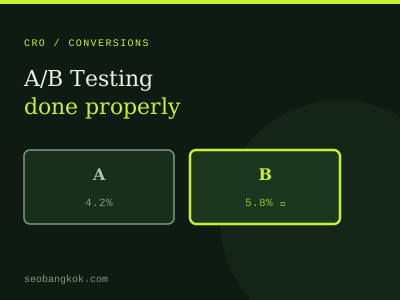
The textbook approach to CRO uses A/B testing with statistical significance thresholds. For most Thai small and medium-sized businesses, this is impractical because the traffic volumes required for statistical significance exceed what the site receives. The practical approach is sequential testing with longer comparison windows.
The honest method. Establish baseline conversion data over a 30 to 60 day window before any changes. Implement one change at a time (ideally) or coordinated changes that work together (acceptable when the changes are clearly complementary). Measure the same conversion metric over another 30 to 60 day window. Compare against the baseline. Decide whether the change is worth keeping based on the trend, not on statistical certainty. For sites with high enough traffic (typically 10,000+ monthly visitors to the tested page), classical A/B testing produces cleaner answers. The methodology specifics are in A/B testing: how to test changes properly.
The honest version of CRO in Thailand
Thai CRO done well is the four levers (LINE integration, PromptPay, Thai trust signals, mobile-first design) on top of a measurement foundation (conversion tracking, baseline data, reasonable testing discipline). The work is not particularly difficult; the gap between Thai businesses that do it and Thai businesses that do not is usually attention rather than budget. Most sites can ship the four levers within a single quarter of focused work and see conversion improvements within the same window.
Our SEO agency Bangkok work with Thai businesses pairs SEO acquisition with the Thai-localised CRO playbook because investing in traffic without investing in conversion is the most common waste pattern we see. The wider digital programmes that combine SEO, PPC, and CRO sit on our digital marketing agency Bangkok service. For businesses where the engagement is more strategic than execution-heavy, an SEO consultant producing the CRO audit and roadmap is often the right shape. The discovery conversation with our SEO consultant in Thailand usually identifies which lever to ship first.
Common questions
How is CRO different for Thai businesses than for western businesses?
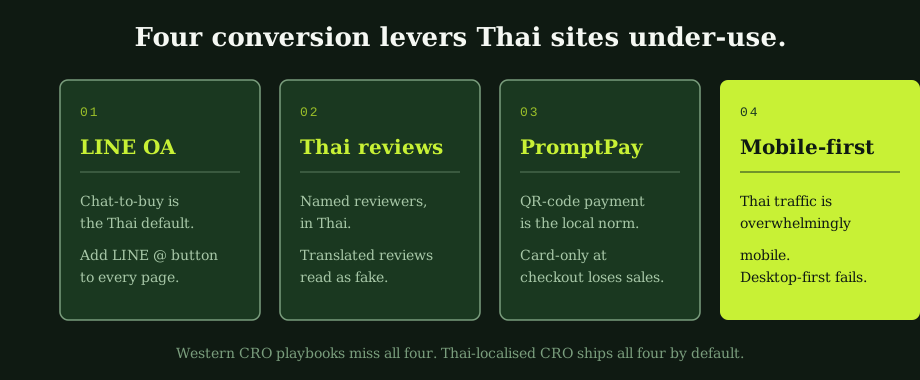
Four structural differences make Thai CRO distinct. LINE sits inside the conversion funnel rather than outside it: Thai customers expect to chat with sellers via LINE before purchasing. PromptPay and bank transfers dominate payment behaviour, so card-only checkouts leak conversions. The Thai market is overwhelmingly mobile-first, so desktop-first designs underperform. Thai-language trust signals (named Thai reviewers, Thai-language testimonials) build trust in a way that translated western reviews do not. Western CRO playbooks miss all four of these.
What is the typical conversion rate for a Thai e-commerce site?
Benchmarks vary widely by industry and audience but typical Thai e-commerce conversion rates run between one and three percent for cold traffic, and between four and eight percent for returning visitors or LINE-chat-converted leads. The ranges are similar to western benchmarks at the aggregate level but the path is different: a significant share of Thai e-commerce conversion happens through LINE chat rather than on-site checkout, which means on-site conversion rate alone understates actual commercial performance.
How important is LINE for conversion in Thailand?
For consumer-facing Thai businesses, LINE is typically the second or third highest converting channel after Google and (often) Facebook. Customers often discover a business through search or social, click through to the website to verify legitimacy, then move to LINE chat to ask specific questions and complete the purchase. Treating LINE as part of the funnel (with prominent LINE buttons on every page, LINE-specific landing pages, and LINE Official Account responsiveness as a conversion factor) typically improves overall commercial performance significantly.
Should Thai businesses test their CRO changes with A/B testing?
Yes, but realistically. A/B testing requires enough traffic to reach statistical significance, which most Thai SMBs do not generate within reasonable timeframes. For sites with under 10,000 monthly visitors to the page being tested, the practical approach is hypothesis-driven sequential testing rather than statistical A/B testing: implement the change, measure for 30 to 60 days, compare against the baseline period, and decide based on the trend rather than statistical confidence. For sites with higher traffic, classical A/B testing is appropriate.