The legal SEO advice that travels well across markets focuses on credentials, case studies, and content depth. The Thai-market version of that advice has to overlay two specific factors: the dual-audience reality (the same firm typically serves Thai clients and expat or foreign clients with substantially different needs) and the YMYL category that puts legal content in the same trust-signal bucket as healthcare and finance. The YMYL sibling vertical that sits at the apex of regulatory complexity is in SEO for financial services in Thailand. Get either layer wrong and the work underperforms regardless of how strong the technical foundation is.
The two audiences for a Thai law firm
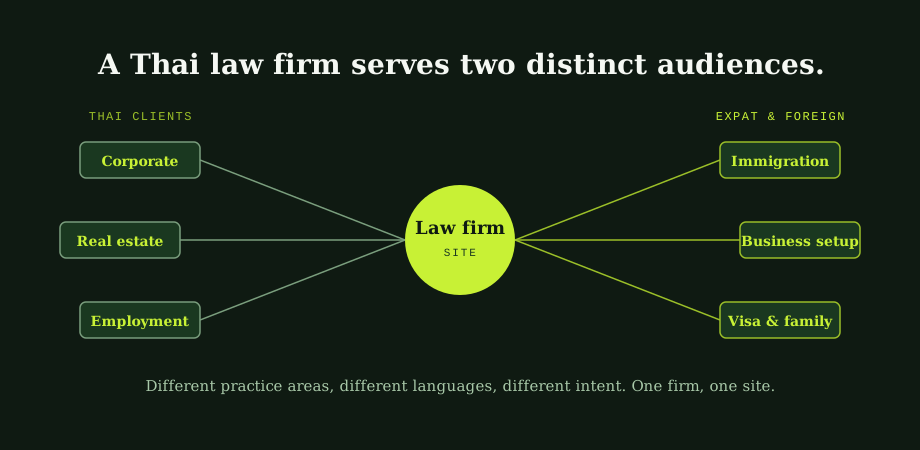
Most Thai law firms of any meaningful size serve two distinct audiences whose research behaviour barely overlaps.
Thai clients search in Thai, default to Google (as the wider Google's market share in Thailand data shows: 99.56 percent of Thai search is on Google), find firms primarily through local pack visibility and Thai-language content, and tend to convert on Thai-language consultations either in-person or over phone. The practice areas that dominate this audience are corporate matters (M&A, contracts, employment disputes), real estate (purchases, leases, condominium disputes), employment law, civil disputes, and family law for Thai couples.
Expat and foreign clients search in English, often arrive in Thailand pre-formed about their legal needs (visa, business setup, immigration, criminal defence, family law for international couples), spend longer in the research phase than Thai clients, and tend to convert through email enquiries or video consultations before any in-person meeting. The practice areas that dominate this audience are immigration, business and company setup, work permits, criminal defence for foreigners, real estate for foreign buyers, and family law for international or mixed-nationality couples.
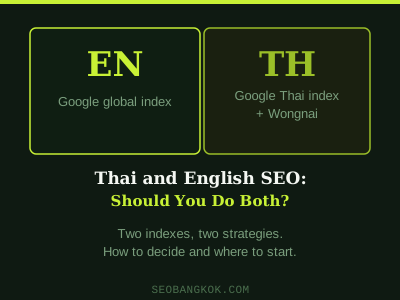
The two audiences are not interchangeable. Content that ranks for Thai-language corporate law queries does not rank for English-language immigration queries, and vice versa. A firm that wants both has to serve both, which is structurally a bilingual SEO programme. The bilingual SEO framing specifically is in Thai and English SEO: should you target both languages; the international-targeting layer is in SEO for Thai businesses targeting foreign customers.
The YMYL trust signal requirements
Legal content is YMYL ("Your Money or Your Life") under Google's quality rater framework. The category exists because Google explicitly raises the trust threshold for content that can affect users' financial, legal, or health outcomes. Legal advice content sits squarely inside it. The practical effect is that the same content with weaker trust signals ranks worse than the same content with stronger trust signals; technical SEO alone cannot compensate.
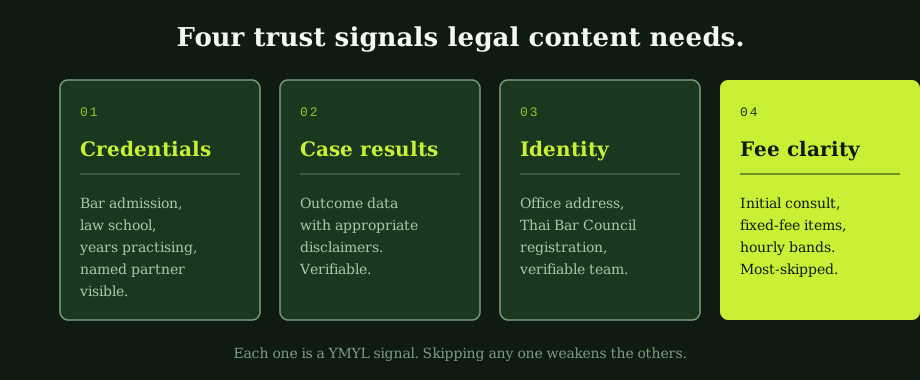
The four trust signals that legal content needs to demonstrate.
1. Verified credentials
Every lawyer who appears on the site needs a biography page with: bar admission jurisdiction and date, law school and graduation year, years of practice, areas of specialisation, named partner status where applicable, professional memberships (Thai Bar Association, foreign bar admissions for dual-qualified lawyers), and a professional photograph. The biography pages are not vanity content; they are entity signals that establish the firm has identifiable practitioners with verifiable credentials. The wider E-E-A-T framework that this rolls into is in what is E-E-A-T and how does it affect rankings.
2. Transparent case results
Case results matter for trust but the disclaimers matter as much as the results. Generic claims ("we win our cases" or "our success rate is 95 percent") are weak. Specific, jurisdiction-appropriate results with proper disclaimers are stronger: "Represented a multinational corporation in a 240 million baht commercial dispute; outcome confidential under settlement terms. Past results do not guarantee similar outcomes; each case turns on its specific facts." This level of specificity demonstrates real practice without overpromising.
3. Verifiable firm identity
The firm itself needs to be findable as a coherent entity: registered office address (not a virtual office for a firm of any size), Thai Bar Council registration number where applicable, named team members with photographs, founded date, and consistent NAP (name, address, phone) information across Google Business Profile, the website, legal directories, and third-party listings. The NAP-consistency framing is in NAP consistency for local SEO.
4. Fee transparency
This is the trust signal that most Thai law firm sites skip and the one that produces the cleanest competitive opening for firms that include it. Fee transparency does not mean publishing a complete fee schedule (most legal work is too matter-specific for that to be useful). It means: clear initial consultation pricing (free or fixed), a list of fixed-fee services where they exist (visa applications, will drafting, basic contract review), hourly rate bands for matters where rates apply, and a statement of how fees are typically structured for complex matters. The transparency builds trust independently of the actual fee level; clients who see clear fee framing convert at higher rates than clients who see opaque "contact us for pricing" pages.
Practice area architecture
Most Thai law firms of any size offer ten to twenty practice areas across multiple audiences. The architectural question is how to structure the site to give each practice area enough depth to rank competitively without diluting the overall authority of the domain.
The recommended structure is hub-and-spoke with the homepage as the central hub, dedicated practice area pages as primary spokes, and sub-service pages or location pages as secondary spokes beneath each practice area.
Each practice area page needs to do three things: explain the area of law at a depth that demonstrates expertise (typically 1,500 to 3,000 words), answer the specific questions clients ask at each stage of their research (often best done as a structured FAQ section), and route the visitor to the appropriate next step (consultation booking, document upload, related practice area if the matter is multi-disciplinary). The shallow practice-area pages that most firms ship at 400 to 600 words do not rank against the firms that ship 2,000-word depth pages with structured FAQ blocks.
For firms serving both Thai and expat audiences, each practice area page needs a version in both languages with correct hreflang implementation. The technical mechanics of hreflang are in hreflang tags explained; the international-SEO context is in our international SEO services for firms with cross-border ambitions.
Local SEO for Thai-audience law firms
For the Thai-audience side of the practice, local SEO is the larger lever. Most Thai clients begin legal research by searching for nearby firms or for specific practice areas in Bangkok, Phuket, Chiang Mai, or other major cities.
The Google Business Profile is the primary surface. The profile needs the firm's exact registered name, complete address, verified phone number, accurate hours including emergency lines if applicable, photos of the office and lawyers, and consistent posting of useful content (legal updates, recent matters at the level of public information, community involvement). The GBP optimisation specifics are in how to optimise Google Business Profile in Thailand.
Citations matter for local rankings. Thai law firms should be listed accurately on the Thai Bar Association directory, Lawyers in Thailand directories, Bangkok-specific business directories, English-language legal directories for the expat audience, and the major Thai-language business listing sites. NAP consistency across all of them is essential.
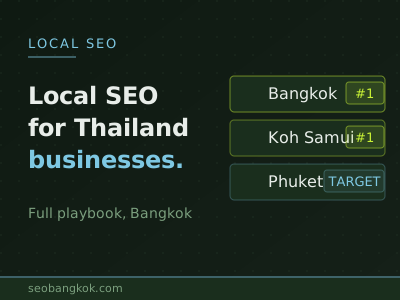
Reviews are the trust signal that matters most after credentials. Firms with consistent five-star reviews and substantive review content (clients describing specific matters and outcomes, with appropriate confidentiality) outrank firms with sparse reviews even when other factors are equal. The wider local SEO foundation for Thai businesses is in local SEO for Thailand businesses; our local SEO services handle the GBP and citations layer for firms that want it operated rather than DIY.
International SEO for expat-audience work
For the expat-audience side, the SEO challenge is different. Foreign clients are usually not in Thailand when they begin researching, so local SEO matters less; what matters more is ranking for English-language queries that originate from the United States, the UK, Australia, Singapore, and the home countries of the firm's typical clients.
The work involves three layers. First, English-language content depth on every practice area that serves international clients, written for the audience's level of legal sophistication (American clients researching Thai business setup do not need basics; they need the specific differences between the US and Thai systems). Second, technical international SEO including hreflang correctness, server geo-targeting where appropriate, and load-speed optimisation for international users. Third, link earning from international sources: law firm directories, expat community sites, business chambers (American Chamber of Commerce, British Chamber, etc.), and English-language Thailand publications.
The ASEAN expansion framing for firms with regional ambitions (Singapore, Hong Kong, Vietnam) is in how to build an SEO strategy for ASEAN expansion.
Content that ranks for legal queries
Legal content that ranks well in 2026 has consistent features.
- Direct answers to direct questions. The question is in the heading, the answer is in the next two or three sentences, supporting detail follows. This is the structure that wins featured snippets, AI Overview citations, and AEO visibility. The wider content shape requirement is in why structured content matters for AI search visibility.
- Named authorship. Each article has a named author (a real lawyer at the firm), with a biography link, a credentials display, and a published date. Anonymous "by our legal team" content does not rank against named-author content in the legal vertical.
- Specific, jurisdiction-aware claims. Generic legal content sourced from international templates does not rank. Thai-specific content that names the relevant Thai law, the specific section number where appropriate, and the Thai court system that adjudicates matters ranks better.
- Substantive length. 1,500 to 3,000 words for practice area pages, 1,200 to 2,000 words for individual articles. Thin content (under 800 words) on legal topics rarely ranks.
- Updated dates. Legal content is time-sensitive (laws change, court decisions update precedents). Showing the last review date and updating the content when the law changes signals freshness and reliability.
- Internal linking to related practice areas. A practice area page should link to the two or three related practice areas where matters often cross over (e.g. a corporate page should link to employment, tax, and immigration where appropriate). Internal linking strength compounds the topical authority of each area.
Common mistakes in Thai law firm SEO
The patterns that recur across underperforming legal sites.
- Thin practice area pages. 400 to 600 words is the most common pattern and rarely ranks against competitors who ship 2,000-word depth pages.
- Anonymous content. "By the legal team" or no author at all. Removes the E-E-A-T signal that legal YMYL content needs.
- No fee transparency. Every page says "contact us for pricing." Skipping the largest available trust signal.
- Monolingual sites for bilingual audiences. Either Thai-only or English-only when the actual client mix is both. Halves the addressable market without saving the SEO investment.
- Generic content cribbed from international sources. American legal content adapted with find-and-replace to "Thailand." Visible immediately to readers and doesn't rank against locally-written content.
- Skipping local pack work. Treating SEO as just content and ignoring GBP, citations, and reviews. The local pack is half of the lower-funnel traffic for most Thai-audience legal work.
- Over-optimised consultation pages. Pages that are 80 percent CTA and 20 percent content. Visitors do not convert from these because the trust foundation is missing.
The honest version of law firm SEO in Thailand
Thai law firm SEO done well requires sustained investment across content, technical SEO, local SEO, link earning, and trust signal work over twelve to twenty-four months. The competitive market is meaningful (the established Bangkok firms have been investing for years), but the bar is not insurmountable: most Thai law firms have under-invested in content depth and trust signals specifically, which leaves clear competitive openings for firms that take the work seriously.
Our SEO agency Bangkok work with Thai law firms typically runs the foundation work (GBP, citations, basic content) in months one to four, then layers content depth across practice areas in months four to twelve. International-audience layers (English content, expat-targeting, international links) sit on top via our international SEO services for firms with foreign-client ambitions. The wider services positioning for legal-vertical work sits on the SEO marketing agency overview. A short discovery session with our SEO marketing experts usually identifies which audience to prioritise and which practice areas to ship first.
Common questions
What makes SEO for law firms different from regular SEO?
Three things make legal SEO structurally different. First, it is YMYL content under Google's quality framework, which means the trust signals matter as much as the technical signals. Second, law firms typically serve multiple distinct audiences across multiple practice areas, so the site architecture has to support deep topical coverage in each practice area without diluting the overall authority. Third, the buyer journey is unusually long and trust-heavy: clients research over weeks or months before booking a consultation.
How should a Thai law firm structure its website for SEO?
The recommended structure is a hub-and-spoke architecture with the homepage as the central hub, dedicated practice area pages as primary spokes, and sub-service pages or location pages as secondary spokes beneath each practice area. Practice area pages need to be substantive (1,500 to 3,000 words minimum). Bilingual implementation (Thai and English) is appropriate for firms serving both Thai and expat audiences; the hreflang implementation has to be correct or rankings get diluted across the language versions.
What YMYL trust signals does Google expect from a law firm site?
Four trust signals are consistently looked for in legal YMYL content. First, verified lawyer credentials: bar admission, law school, years practising, named partners visible with biographies. Second, transparent case results with appropriate disclaimers. Third, verifiable firm identity: registered office address, Thai Bar Council registration where applicable. Fourth, fee transparency: initial consultation pricing, fixed-fee items where they exist, hourly bands for matters where rates apply. The fee transparency point is the most-skipped.
Should a Thai law firm target expat clients or Thai clients first?
It depends on the firm's existing client mix and the practice areas. Firms with strong corporate, real estate, and employment law practices that already serve Thai businesses should typically prioritise Thai-language search and local SEO foundations first. Firms specialising in immigration, business setup, criminal defence for foreigners, or family law for international couples should typically prioritise English-language search and international SEO. The hybrid model requires more investment but produces a more defensible market position over time.