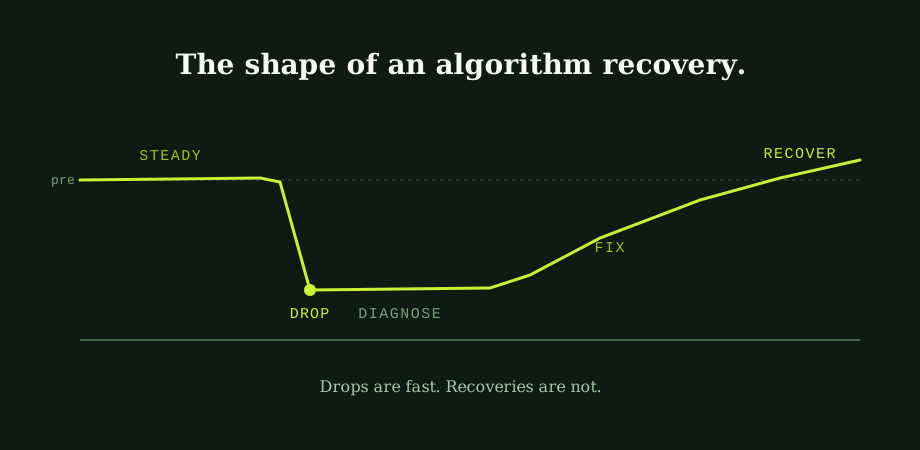
Before any of the recovery work, the reality of the situation. An algorithm update is not a penalty. There is no manual review, no reconsideration request, no human at Google to appeal to. Google's models updated their judgement about which pages are the best answers to which queries, and your pages came out lower than they did before. The recovery path is to genuinely become a better answer, then wait for the next model update to notice.
That waiting is the part most teams underestimate. Recoveries take longer than drops. Always.
Was it actually an algorithm update?
The single most common diagnostic mistake is assuming an algorithm update is responsible when something else is. Three checks distinguish between genuine algorithm impact and look-alike causes.
- Match the date. Google announces broad core updates, spam updates, and link spam updates on the Search Status Dashboard, with start and end dates. If the drop falls cleanly inside an announced rollout window, the update is almost certainly the cause. If it does not, look elsewhere first.
- Rule out technical causes. An indexing problem, a server outage, a robots.txt change pushed to production, a CDN misconfiguration, an accidental noindex tag: each of these can produce traffic patterns that look identical to an algorithm hit. The diagnostic flow for the technical possibilities is in how to fix indexing problems in Google Search Console, and worth running before assuming an algorithm cause.
- Check for query-driven decline. If demand for your keywords fell because the world changed (a brand stopped advertising, a product category lost relevance, a seasonal pattern), no algorithm update is involved. Compare your Search Console impressions with Google Trends data for your top queries.
If the drop matches an announced update window, and the technical and query checks come up clean, the algorithm is the cause. Move to step two.
Which update probably hit you
Different updates have different signatures. The recovery path depends on which one is responsible.
Core updates are broad re-weightings of how Google judges page quality and topical authority. They affect every kind of site and every kind of query. Pages that lose rankings in a core update typically do so because their content quality, trust signals, or topical depth have fallen behind competitors that have been steadily improving. Recovery for core updates is the slowest and most diffuse, because the fix is often "become a meaningfully better answer," not a single technical change.
Spam updates target manipulative behaviour: unnatural link patterns, doorway pages, cloaking, scraped content. Recovery requires removing the manipulative signal, after which the site usually returns to where its non-manipulative quality supports it. If you are uncertain whether you have a spam exposure, an honest review of recent link-building activity and content production tends to surface the answer quickly. The principles of clean link earning sit in how to earn high-quality backlinks and the anchor-text profile rules in anchor text best practices for SEO.
Link spam updates are a subset of spam updates focused specifically on the link graph. The signal Google is removing is usually weighted backlinks from manipulative sources, so recovery often shows as a one-time correction once the bad links stop counting.
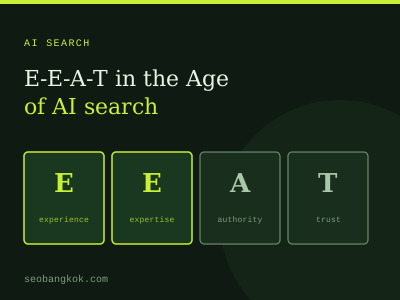
Helpful Content signals, which were merged into the core update system in 2024, target pages designed primarily to attract search traffic rather than to genuinely help readers. The diagnostic question is honest: was this page written to be useful, or to rank? Sites that built libraries of thin, formulaic content during 2020-2023 are the ones still recovering from this layer of judgement. E-E-A-T in the age of AI search covers the related framework Google uses to assess quality.
How to diagnose which pages
The most important pivot in any recovery is from "the site dropped" to "which specific pages dropped, for which specific queries." Aggregate numbers hide the pattern. Per-page and per-query data reveals it.
Open Search Console, set the date range to the thirty days before and after the update, and look at the Pages report ordered by absolute change in clicks. The pages that lost the most are the diagnosis target. Then open each of those pages individually, set the date range the same way, and look at which specific queries lost impressions and clicks on each. The pattern is usually clearer per page than across the whole site.
Three patterns tend to emerge.
- Specific pages collapsed, others unchanged. Almost always a quality or relevance signal at the page level. The fix is targeted: rewrite, expand, or replace those specific pages.
- Specific query types lost across many pages. Often a search-intent shift: Google decided a different kind of page is the better answer for those queries. The fix is a format change rather than a content change.
- The whole site dropped relatively evenly. A site-wide signal: trust, authority, link spam, or technical health. The fix is foundational rather than page-by-page.
Diagnose which of the three patterns you have before fixing anything. The wrong diagnosis leads to wrong fixes, which produce nothing.
The recovery workflow
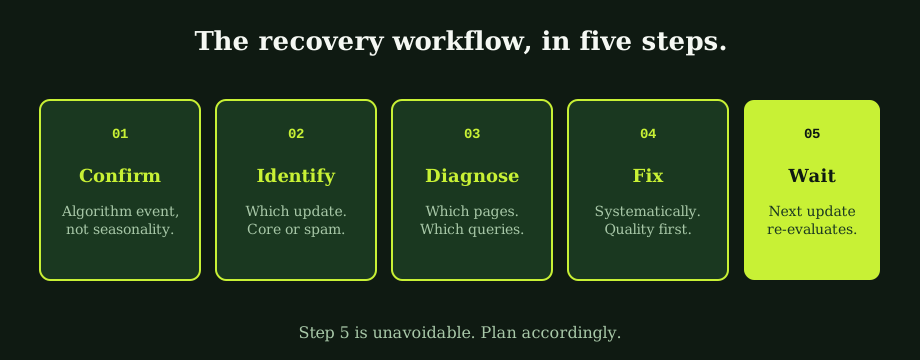
For a core update affecting specific pages, the fix order that produces the strongest signal.
- Rewrite the worst-affected pages to be meaningfully better answers. Not longer; better. Add the information competitors are missing. Remove the filler. Update outdated sections. Bring in named expertise. Add original research, original examples, or original photography where you can.
- Improve internal links to the affected pages. Pages that lost ranking often also lost internal-link weight as the rest of the site reorganised attention. Re-link to them from your strongest pages, with varied descriptive anchor text.
- Tighten the trust signals. Named authors, last-updated dates, sources, credentials. The trust signals reading framework is the one Google uses to judge quality; the deeper view sits in E-E-A-T in the age of AI search.
- Address site-wide quality if relevant. If the pattern is site-wide rather than page-level, look at thin or duplicate content, low-value programmatic pages, and any sections that exist primarily for SEO rather than for users. What is thin content covers the assessment criteria.
- Document everything. Date, page, change, hypothesis. When recovery starts to show, you want to know which changes correlate with which signals. Without documentation, the next algorithm update is harder to recover from because you cannot tell what worked.
Why recoveries take longer than drops
Google has been explicit on this: changes made after a core update are not evaluated until the next core update runs. The model that decided your rankings was frozen at a specific date. Until Google decides to retrain that model and re-rank, your fixes sit in reserve. In calendar terms, that usually means three to nine months between fix and signal change. Sometimes longer.
The implications for project planning are large. Recovery is not measured in weeks. Stakeholders expecting fortnightly progress updates need to be reset to monthly. Quality fixes done in week two of recovery are visible in the SERP somewhere between month three and month nine. Anyone who promises faster is selling something other than recovery.
The broader principle around realistic timelines sits in how long does SEO take, and applies twice over to algorithm recovery.
What not to do
Some reactions reliably make recovery harder.
- Do not panic-publish more content. Producing more low-quality content compounds the problem the update flagged.
- Do not aggressively disavow backlinks unless you have direct evidence they are manipulative. The disavow tool is a precision instrument; used broadly it removes legitimate links that were supporting your rankings.
- Do not file a reconsideration request. Reconsideration applies only to manual actions, which are different from algorithmic adjustments and visible in the Manual Actions section of Search Console. Algorithm updates have no reconsideration path.
- Do not abandon the affected pages and start a new site. A new site inherits no authority and starts from zero, which is almost always worse than recovering an established one.
- Do not change everything at once. Without attribution, future recovery signals cannot be traced to specific fixes. Make a series of changes, document each, and watch the signal.
The honest version of recovery
An algorithm update is Google's model updating its answer to "what counts as a good result for this query." The site that recovers is not the one that fixes the most tags. It is the site that genuinely becomes a better answer than it was before. The technical work matters because it makes the better answer visible; the quality work matters because it makes the answer better. Both are necessary. Neither alone is sufficient.
Our SEO agency in Thailand handles algorithm recovery engagements for sites that need the diagnosis, the prioritisation, and the disciplined execution that the workflow above describes. An SEO consultant in Thailand can run the first-hour diagnostic on your traffic data and tell you which pattern you are looking at before any recovery work begins. Our SEO agency in Bangkok works with leadership on the realistic-timeline conversation that has to happen at the same time, because the planning around recovery matters as much as the recovery itself.
Common questions
How long does it take to recover from a Google algorithm update?
Recovery from a Google core update typically takes between one and three core update cycles, which in calendar terms usually means three to nine months. Google has been explicit on this: changes you make after a core update are not evaluated until the next core update runs, because the model that judged you was frozen at a particular date. There is no manual review path for core updates. The work you do today is held in reserve until Google decides to re-evaluate.
What is the difference between a core update, a spam update, and a Helpful Content update?
A core update is a broad re-weighting of how Google evaluates the overall quality and relevance of pages across every type of search. A spam update specifically targets manipulative behaviour like unnatural link patterns, cloaking, and scraped content. A link spam update is a subset that focuses on the link graph. The former Helpful Content update has been folded into the core update system since 2024, but the principles still apply: pages designed primarily to attract search traffic rather than to genuinely help readers are devalued.
Can I tell which Google update affected my site?
In most cases yes, by matching the drop date to Google's public update history. Google announces broad core updates, spam updates, and link spam updates on its Search Status Dashboard, with start and end dates for each rollout. If your drop falls cleanly inside one of those windows, the update is almost certainly the cause. If it does not, the drop may be technical, competitive, or query-driven.
What should I not do after an algorithm update drop?
Several reactions reliably make recovery harder. Do not panic-publish more content; producing more low-quality content compounds the problem. Do not strip backlinks aggressively unless you are certain they are manipulative. Do not file a reconsideration request with Google for an algorithm update; reconsideration only applies to manual actions. Do not abandon the affected pages and start a new site. Do not change the entire site at once; you will not be able to attribute any future recovery signal to a specific fix.
If the recovery path is still unclear after a few weeks of data, a structured SEO audit beats guessing. It separates what the update actually affected from the problems that were already there.
Before attributing a decline to an update, rule out the simpler explanations first. Diagnosing a traffic drop covers the checks that come before any recovery work.