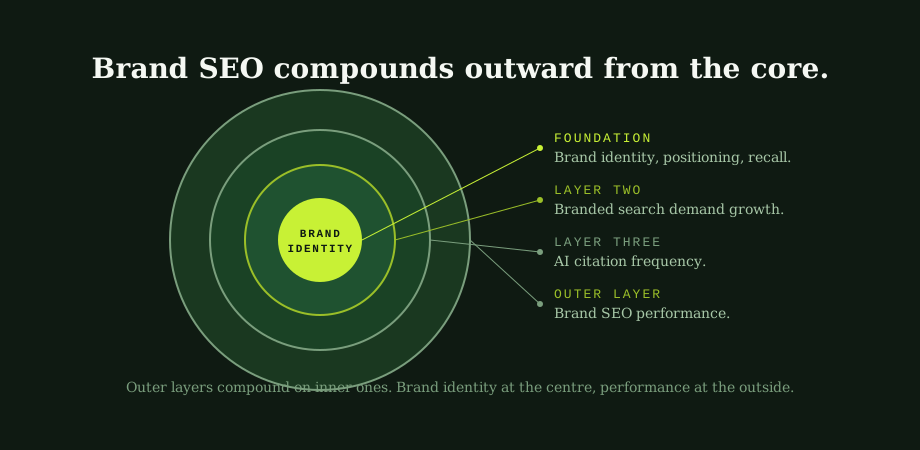
The conceptual model that makes brand SEO tractable is the four-layer onion. At the centre sits brand identity, the positioning and recall work that traditional marketing has always covered. Around that grows branded search demand, the volume of Google searches for the brand by name. Around that grows AI citation strength, the frequency with which AI search engines cite the brand in answers to category queries. The outer layer is brand SEO performance, the integrated outcome that compounds when the three inner layers are healthy. The layers build outward; performance at the surface depends on identity at the core.
What brand SEO actually is
The simplest definition: brand SEO is the work of building organic search performance through brand strength rather than through page-level optimisation alone. The page-level work (technical SEO, content depth, internal linking, schema markup) still matters and is not replaced; brand SEO is the upstream factor that determines how much commercial value the page-level work produces.
A useful way to see the distinction. Two businesses ship technically identical SEO programmes (same technical foundation, same content depth, same internal architecture). One is a known brand in the category; the other is unknown. The known brand outranks the unknown brand on most commercially relevant queries because Google and AI engines treat the known brand as more authoritative regardless of how strong the page-level signals are individually. The gap is not on what is on the page; it is on what the search engine knows about the publisher of the page.
Branded versus non-branded search
The most basic operational distinction in brand SEO is between branded queries (searches that include the brand name) and non-branded queries (searches for the category without a brand reference). Both are valuable but they serve different functions in the overall programme.
Branded queries represent recall and recognition. Someone searching for the brand by name has already been exposed to the brand through some prior channel (advertising, word of mouth, AI mention, social referral, direct experience) and is now seeking it out specifically. Branded queries convert at multiples of non-branded queries because the user has already self-selected; they are looking for this specific brand rather than browsing options.
Non-branded queries represent discovery. Someone searching the category without a brand name has not yet decided which brand to consider. Ranking on non-branded queries is how new customers find the brand for the first time, but the conversion rates are lower because the audience has not yet developed brand preference.
For established brands, branded queries typically represent 30 to 40 percent of total organic traffic and a much larger share of conversion value because of the higher conversion rate. For new or unknown brands, branded queries can be under 5 percent. Brand SEO work raises both the volume of branded queries (more people search for the brand by name) and the share of non-branded queries that the brand can compete for (the brand is increasingly considered for category searches).
Why brand SEO matters more in 2026
The discipline became distinct in 2025 and 2026 because of two structural shifts that elevated brand equity as a search ranking factor.
AI search engines cite brands they recognise. ChatGPT, Gemini, Perplexity, and Claude all show systematic bias toward citing established brands in their answers to category queries. A search for "best CRM for Thai SMBs" surfaces named brands the AI engines recognise as authoritative; brands without sufficient entity strength get mentioned only when explicitly named in the user's query. The mechanics of how AI engines decide what to cite are unpacked in what AI search engines look for when citing sources; the underlying entity strength work that makes brands citable is in entity SEO for AI search.
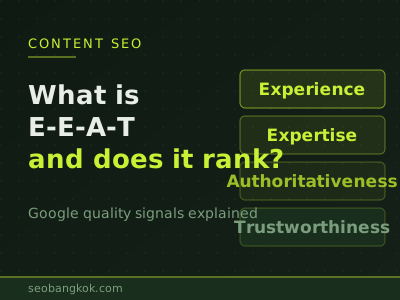
Google's E-E-A-T framework weights brand authority signals more heavily. Named senior authors, third-party citations, entity strength on Wikipedia and Wikidata, structured data identifying the publishing organisation, and consistent brand mentions across the web all factor into how Google evaluates content quality. Two articles with identical content but different publisher entity strength rank differently because Google reads the brand strength as evidence of expertise and trustworthiness. The wider E-E-A-T framing that this rests on is in what is E-E-A-T and how does it affect rankings.
The compounding effect of these two shifts is what makes brand SEO a distinct workstream rather than an extension of traditional SEO. A brand investing in brand equity sees the returns compound across both Google ranking and AI citation simultaneously; a brand neglecting brand equity sees results stall on both surfaces regardless of how much it invests in page-level work.
Brand entity strength as a ranking signal
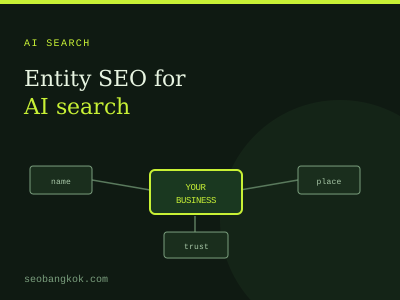
Entity strength is the technical mechanism through which brand equity affects search ranking. Google maintains an internal knowledge graph that catalogues entities (people, organisations, products, locations) and their relationships. AI search engines maintain similar entity representations in their training data and retrieval systems. A brand with strong entity representation appears in the knowledge graph with rich attributes (founding date, headquarters, key people, products, industry); a brand with weak entity representation appears either with sparse attributes or not at all.
The signals that build entity strength. Wikipedia and Wikidata presence (the single highest-impact signal because both Google and AI engines treat these as authoritative). Schema.org structured data on the brand's own site (Organization markup with consistent attributes). Third-party citations across credible publications (industry trade press, mainstream business media, sector-specific authoritative sites). Consistent brand representation across social platforms, professional networks, and review platforms. Sustained earned media coverage that reinforces the brand's category positioning.
The entity work is upstream of the SEO work. A brand without a Wikipedia entry, without Organization schema, and without third-party citations cannot compete on entity-driven queries regardless of how strong its on-site SEO is. The wider context on how this fits into the modern SEO discipline is in the state of Thai SEO in 2026.
Brand mentions in AI surfaces
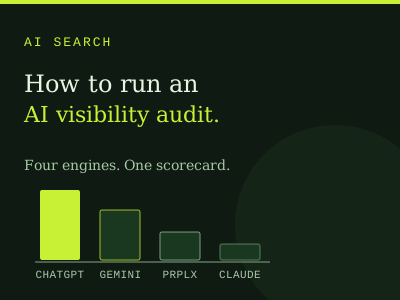
Brand mention frequency in AI search answers is now a measurable component of brand SEO. The mechanics of measurement run through the AI visibility audit methodology, which scores brand mentions across the four major AI engines for a defined query set. The audit framework specifically for this is in how to run an AI visibility audit; the practical operational version of checking AI visibility is in how to check if your brand appears in AI search results.
The patterns that emerge from these audits are consistent. Established brands with strong entity representation get cited across multiple AI engines for category queries. New or unknown brands rarely appear unless the query explicitly names them. The gap between named and unnamed brands in AI surfaces is wider than the equivalent gap in Google ranking, because AI engines rely more heavily on entity recognition than on document-level signals when constructing answers from training data.
The practical implication for brand SEO is that AI visibility work has to be approached as brand equity work, not as content optimisation work. Writing more pages or improving meta descriptions does not move the needle on AI citation frequency; building entity strength does.
Measuring brand SEO performance
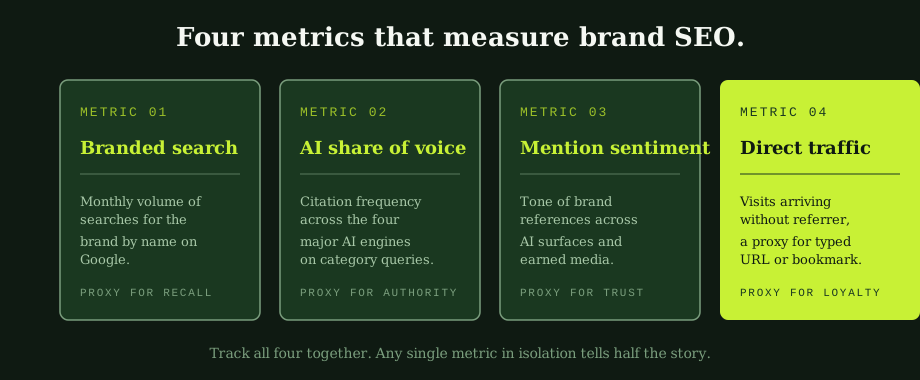
Four metrics measure brand SEO from different angles. Tracking all four together produces a complete picture; tracking any single one in isolation misses important diagnostic information.
Branded search volume. Monthly volume of Google searches for the brand by name. The most direct proxy for brand recall. Growth in branded search volume indicates the brand is being remembered and sought out by more people; flat or declining branded volume indicates brand awareness work is not compounding.
AI share of voice. Citation frequency across the four major AI engines on a defined set of category queries. Proxy for brand authority within the category. Higher share of voice indicates the brand is being treated as a category-relevant entity; lower share indicates the brand needs entity strength work.
Mention sentiment. The tone of brand references across AI surfaces and earned media. Proxy for brand trust. Positive mentions indicate the brand is being represented favourably; negative or mixed mentions indicate reputation issues that need addressing before further volume growth becomes valuable.
Direct traffic. Visits arriving without a referrer (typed URLs, bookmarks, direct sessions). Proxy for brand loyalty. Growing direct traffic indicates the brand is being remembered by name and sought out directly; flat direct traffic indicates the brand is not building memorable position with its audience.
The four metrics together give a complete picture. A brand with growing branded search but flat direct traffic has awareness but not loyalty; a brand with strong AI share of voice but poor sentiment has recognition but not trust. Each combination signals different operational priorities. The wider measurement framework that this fits inside is in how to measure SEO content performance.
How brand SEO connects to traditional SEO
Brand SEO and traditional SEO are not competing disciplines; they compound. A site running strong traditional SEO without brand investment captures long-tail queries but loses head-term traffic to better-known competitors. A brand running strong brand SEO without traditional SEO captures branded and category queries but loses the long tail. The integrated programme covers both.
The sequencing matters. For new or unknown brands, traditional SEO produces results faster (specific page-level work shows up in rankings within weeks to months); brand SEO compounds slower (entity strength takes quarters to years to develop meaningfully). The pragmatic approach is to run both in parallel rather than sequencing them: traditional SEO for short-term traffic, brand SEO for long-term compounding.
For established brands, the leverage often inverts. The brand SEO work has more headroom because the page-level SEO has already been built to a competent baseline; further page-level optimisation produces marginal gains, while brand equity work produces step-function increases in category positioning. Established brands that under-invest in brand SEO leave compounding value on the table.
Common mistakes in brand SEO
- Treating brand SEO as a marketing concern separate from SEO. The two are now linked; siloing them prevents the integrated work that produces the best outcomes.
- Measuring only branded search volume. One metric out of four tells a quarter of the story. AI share of voice, sentiment, and direct traffic all need tracking.
- Focusing entirely on AI visibility while ignoring entity strength. Visibility is the outcome; entity strength is the input. Working on the outcome without addressing the input rarely produces sustained results.
- Pursuing brand mentions without quality control. Negative mentions, low-quality citations, and association with low-authority sources damage brand SEO. Volume is not the only dimension.
- Expecting fast results. Brand SEO compounds over quarters and years, not weeks. Investing for two months and giving up is the classic failure mode.
- Ignoring Wikipedia and Wikidata. The single highest-leverage entity strength signal, and the one most brands neglect because the editing process is unfamiliar.
- Inconsistent brand representation. Different brand names, descriptions, and category positioning across platforms confuses both Google and AI engines about the brand entity.
- Vanity-metric reporting. Mention counts without sentiment or quality dimension. The reporting expectations that the modern discipline requires are in SEO reporting: what to show stakeholders.
The honest version of brand SEO
Brand SEO done well is the upstream investment that makes traditional SEO compound rather than plateau. It takes years rather than quarters to build the entity strength and brand recognition that produce step-function improvements in category positioning. The brands that take it seriously and invest at the level the discipline requires accumulate compounding visibility advantages across both Google and AI search. The brands that treat brand SEO as a tactical layer to bolt on top of traditional SEO end up disappointed because the underlying brand equity work was never properly funded.
Our positioning as a best SEO Bangkok agency includes brand SEO as a structural component of multi-year engagements rather than a stand-alone offering. The integrated SEO company in Bangkok programme treats brand equity work as a coordinated workstream alongside page-level SEO. For AI-citation-specific brand SEO work, the LLM visibility optimization service covers the AI surface layer specifically. A discovery conversation with our SEO specialist Bangkok typically identifies whether the business has reached the maturity where brand SEO investment will produce compounding returns or whether the traditional SEO foundation needs more depth first.
Common questions
What is brand SEO?
Brand SEO is the discipline of growing organic visibility through brand equity rather than primarily through page-level optimisation. The programme compounds four layers outward from a core: brand identity (positioning, recall), branded search demand, AI citation strength, and brand SEO performance. The discipline emerged as distinct because brand equity now affects both Google ranking and AI citation behaviour in ways that page-level work cannot replicate.
How is brand SEO different from traditional SEO?
Traditional SEO focuses on optimising individual pages to rank for specific queries. Brand SEO focuses on the upstream factor that makes traditional SEO compound: brand equity strong enough that Google and AI engines treat the brand as authoritative across its category. The two disciplines complement rather than compete. The integrated programme covers both.
Why does brand SEO matter more in 2026 than five years ago?
Two structural shifts elevated brand SEO. AI search engines now cite brands they recognise as authoritative entities, so brand equity directly drives AI citation behaviour. Google's E-E-A-T framework has become more sophisticated at identifying brand authority signals and weighting them in ranking decisions. Both shifts mean that brand equity is no longer a parallel marketing concern; it is an upstream input that shapes SEO outcomes directly.
What are the core metrics for brand SEO?
Four metrics measure brand SEO from different angles. Branded search volume (proxy for recall). AI share of voice across the four major AI engines (proxy for authority). Mention sentiment across AI surfaces and earned media (proxy for trust). Direct traffic (proxy for loyalty). Any single metric in isolation tells half the story; the four together give a complete picture.